
Sindhi Curry
Nutty, tangy and with a hint of spice, this is a roasted chickpea-flour-based curry that is slowly simmered with vegetables. A highlight of the Sindhi cuisine, it is both exquisite and comforting.

Story and recipe developed in collaboration with Neena Moorjani.
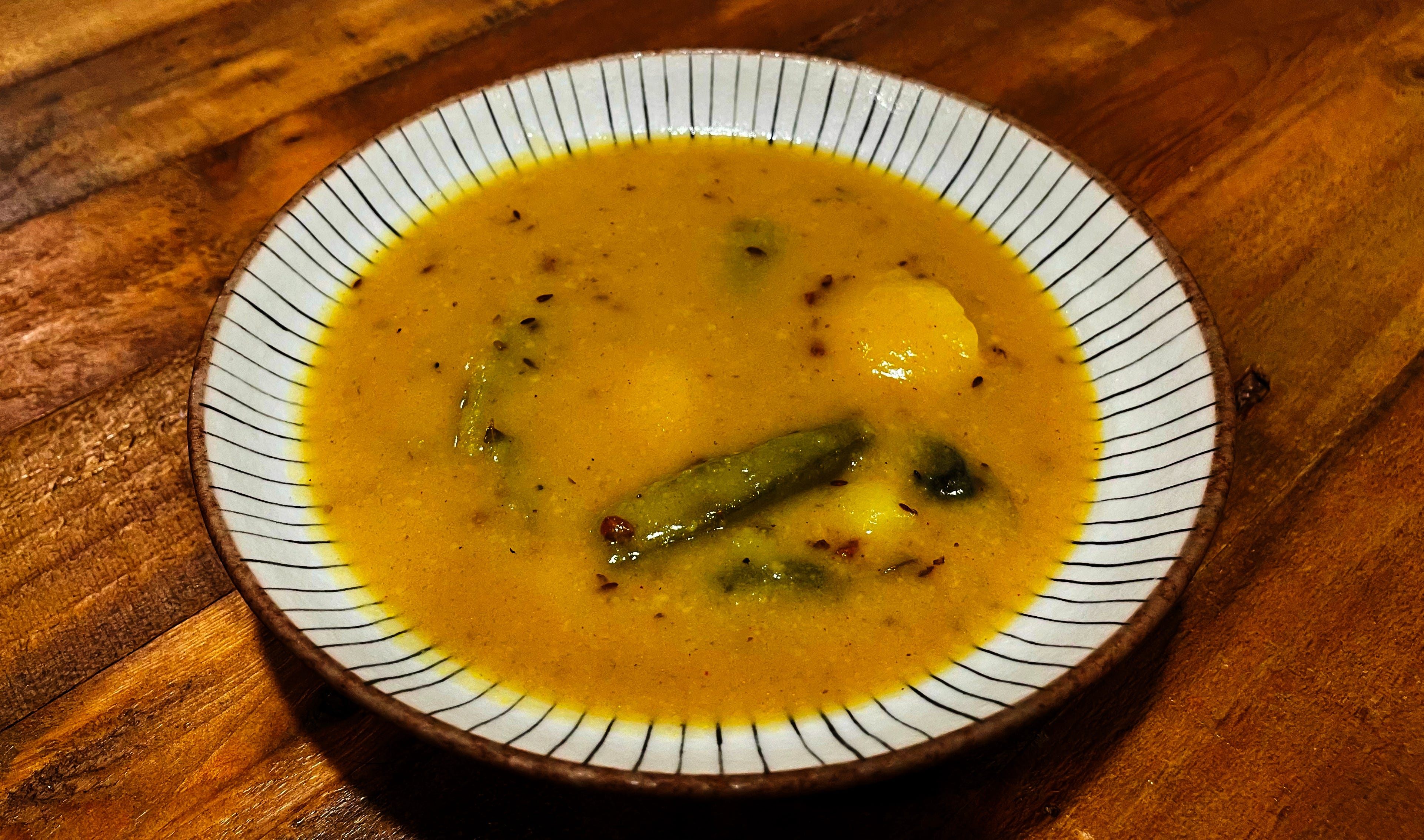
If I could choose my last supper on earth, it would have to be my mom’s Sindhi curry
I remember those sunny Sundays from my childhood in Bombay (India). It was not our typical lazy Sunday. We had barely finished breakfast, but lunch was already cooking. The heady aroma of roasted chickpea flour wafted through our apartment. It made me happy. I knew that I was in for a treat. My mom was cooking Sindhi curry, an elaborate vegetarian stew that requires slow simmering to develop its rich flavors. I was happy to wait. The more it simmered, the more flavor it would pack.
Sindhi curry, or more traditionally known as Sindhi kadhi, is a highlight of Sindhi gastronomy and is often prepared during festivals and family gatherings. It is an unusual chickpea-flour-based curry that lacks tomatoes, ginger, garlic or onions, ingredients which are quintessential to most Indian curries. It is prepared in a heavy-bottomed copper or brass traditional pot, called sipri, which is ideal for slow cooking.
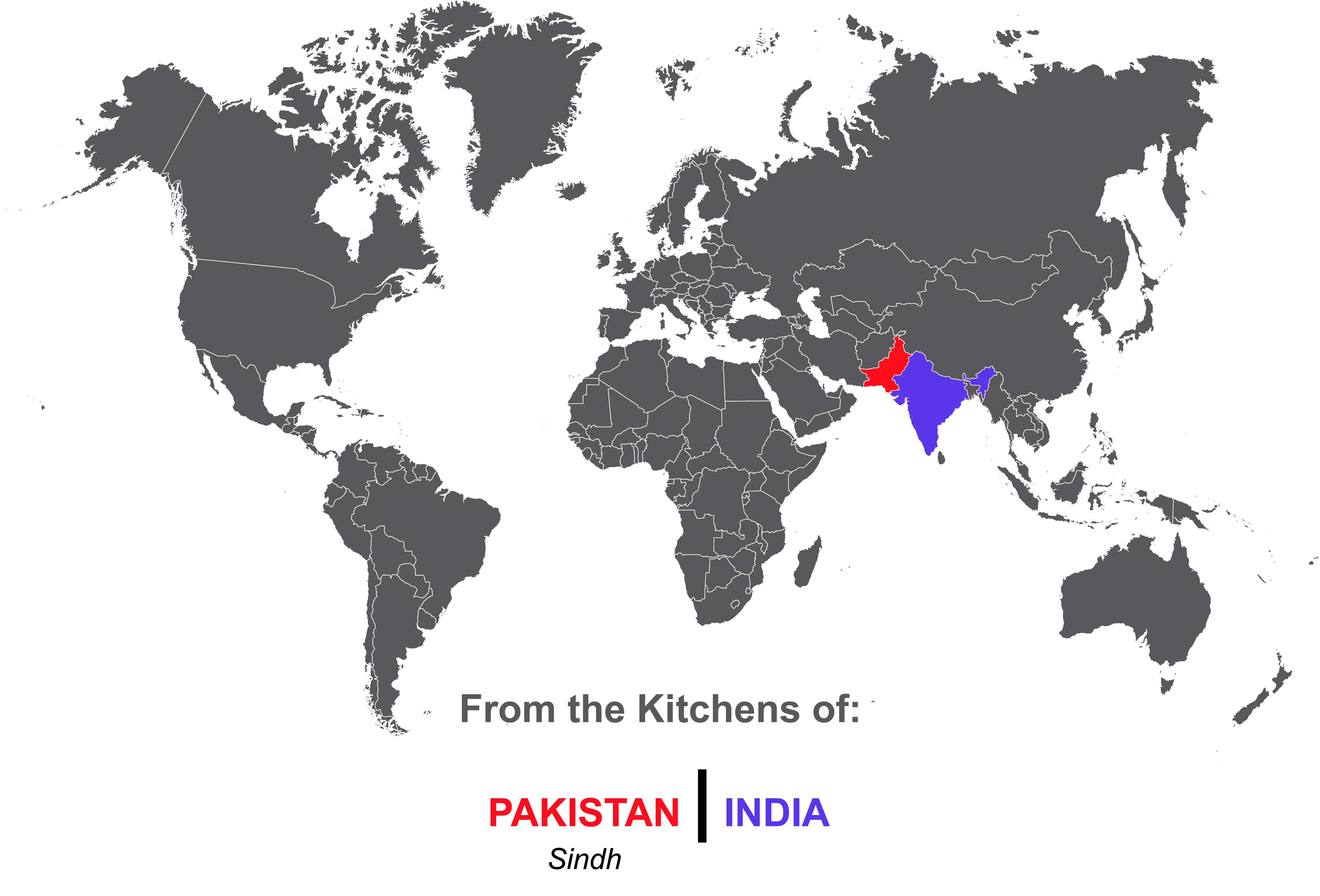
Sindhis trace their roots to Mohenjo-daro—the largest settlement of the ancient Indus Valley Civilization—which was in the present-day province of Sindh (in Pakistan). Hindu Sindhis, the vast majority of which now live in India, were pushed out of their ancestral lands following the partition of British India into two independent nation states: a predominantly Hindu India and the Islamic Republic of Pakistan. While the Partition occurred soon after independence from British colonial rule in 1947, during which Sindh was handed over in its entirety to Pakistan, Hindu Sindhis had held on to hopes of being able to continue living on their lands and not follow the fate of Hindus in Punjab and Bengal. Despite deeply rooted ties to the land and a longstanding culture of assimilation and harmony with their Muslim neighbors, Hindu Sindhis, who were the minority in the region, were forced out in 1948. Yet, by and large, the exodus of Hindus from Sindh was peaceful, in stark contrast to the unfathomable violence in Punjab and Bengal, and this was in no small part due to the Sufi-influenced culture of religious tolerance in Sindh, shared by both Hindus and Muslims alike in the region. Those who left, however, would never see their ancestral lands again. The Partition of India is recorded as the world's largest human migration, with more than 15 million Hindus and Muslims collectively forced to leave their lands.
Words simply cannot describe the unimaginable loss of this generation. The loss of their lands, homes and, above all, a sense of belonging. How do you express your culture and identity in an unfamiliar environment? Perhaps this expression, which is central to our souls, needs to be muted for practical reasons of survival in an unknown land. How do you then keep your culture alive?
It is no surprise that immigrants across the world have found this sense of belonging, comfort and continuity through food after being uprooted. Most cultural practices and rituals need to adapt to new environments and local populaces; culinary traditions, however, are more immune. Family recipes have always been passed down orally, from one generation to the next, which ensures continuity. Hindu Sindhis rebuilt their homes and lives in new towns and cities and, over time, became rare examples of successful assimilation with the local majority population (once again). The price though was paid by muting their identity and culture in an effort to blend in and not attract unwanted attention. Not surprisingly, Sindhi cuisine never became mainstream in India. Its expression, however, stayed strong in Sindhi households across the country and provided the necessary bridge between the old and the new, the familiar and the unfamiliar, the past and the present. The same dishes continued to be cooked, and still do, in Sindhi homes across India (and across the border): koki, dal pakwan, sai bhaji, pallo and, above all, Sindhi curry. The latter is central to Sindhi cuisine. One can only imagine what comfort it brought to those who were displaced and found themselves in a land where everything was foreign.
I am not sure what makes my mom's Sindhi curry so flavorful (and soulful). I have always reached the same conclusion after having versions prepared by my many aunts: they do not compare to my mom’s curry. Perhaps it is the familiarity of her curry, which evokes a sense of comfort and satisfaction that is hard to match. It can put me in a trance and cut me off from whatever is going on outside, if only for a little bit.
Sindhi curry is traditionally served with rice. I prefer my curry without any rice though on the day that it is prepared. Three bowls of piping hot curry is how I have always liked it. My mom leaves the sipri on the gas stove on the lowest flame possible for me to fill my bowl with hot curry each time. After having my fill on the day that it is prepared, I look forward to leftovers to enjoy the curry in the traditional manner with rice on the next day.
As I conclude this story, the realization that Sindhi curry has never been part of my cooking routine is not lost on me. Neither is the recognition that I also have a role to play in the continuity of this culture and gastronomy. So voilà, here is an attempt to reproduce my mom’s flavors.
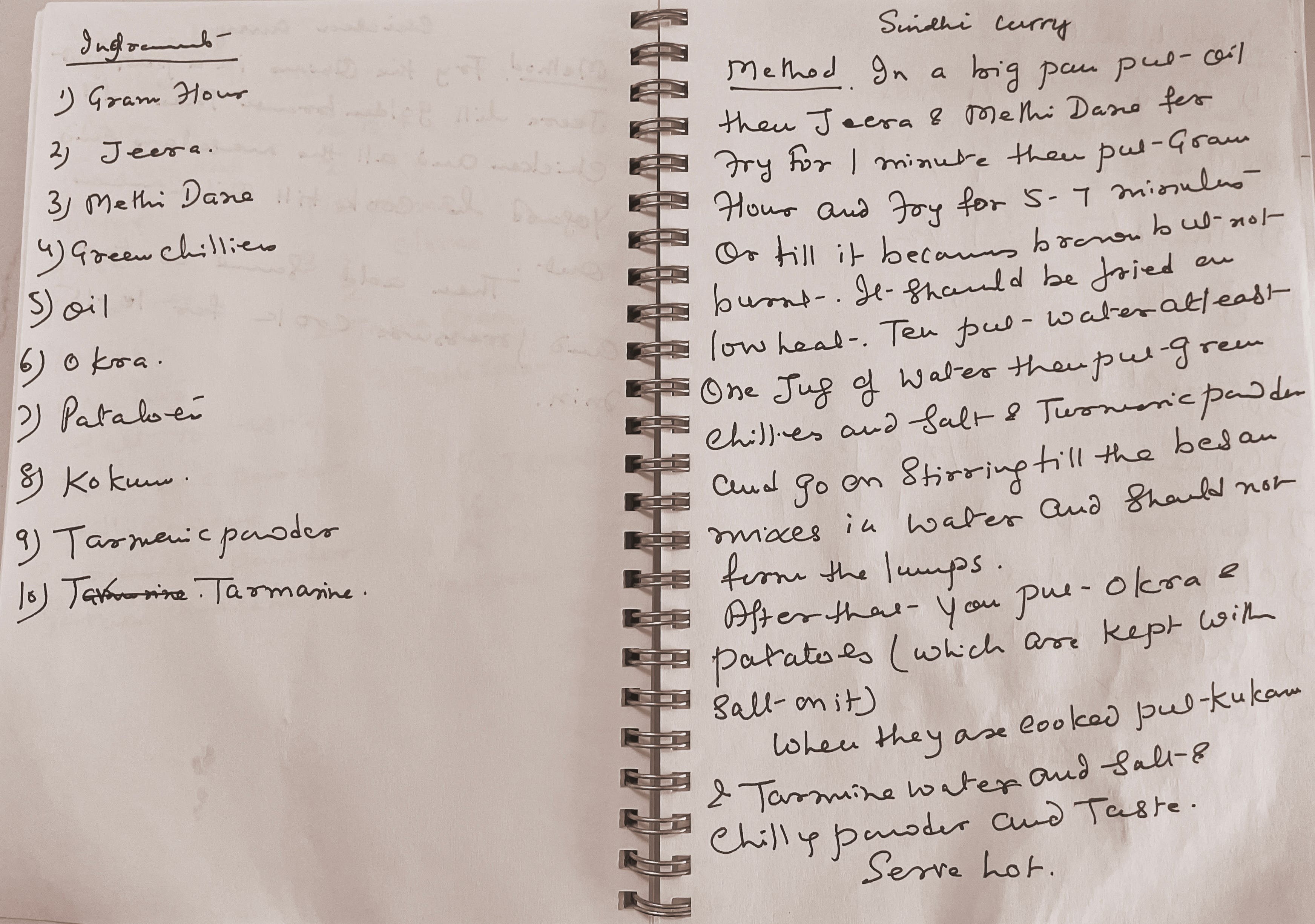
I started with my mom’s bare-bones recipe. You see, Indian mothers cook with their noses (and their hearts). My mom only ever uses measuring cups and spoons when she bakes a cake. With her recipe in hand, and some text messages and phone calls to India, I set out to recreate her flavors in my kitchen. I started with tempering cumin and fenugreek seeds in oil, which was followed by curry leaves and chickpea flour. I roasted the flour slowly until it changed color—from a pale yellow to golden-brown—and exuded a heady aroma. Then I added water, a lot of it, and a minced green chili. My son and I tasted the curry at every step. It was an eye-opening, and a nerve-wracking, process. For the first 20 minutes or so, the curry tasted like, well, chickpea-flour-in-water. After we added some okra and potatoes, and simmered more, the flavors from the vegetables started to transform the curry. We waited for another 20 minutes to allow the vegetables to cook. Now we had something in the vicinity of a lentil soup (or dal) with vegetables in our hands. It was a nutty chickpea-flour-based vegetarian stew with a hint of spice, alright. It was time to add the last, i.e., the tangy, element to the curry: tamarind and kokum. Five more minutes, and voilà, it evolved into an exquisite, comforting and moreish dish that is nourishing at the same time, so you don't have to feel guilty about having (three) bowlfuls of it.
No two cooks will ever make the same Sindhi curry. Needless to say, Mom’s curry is better, of course!
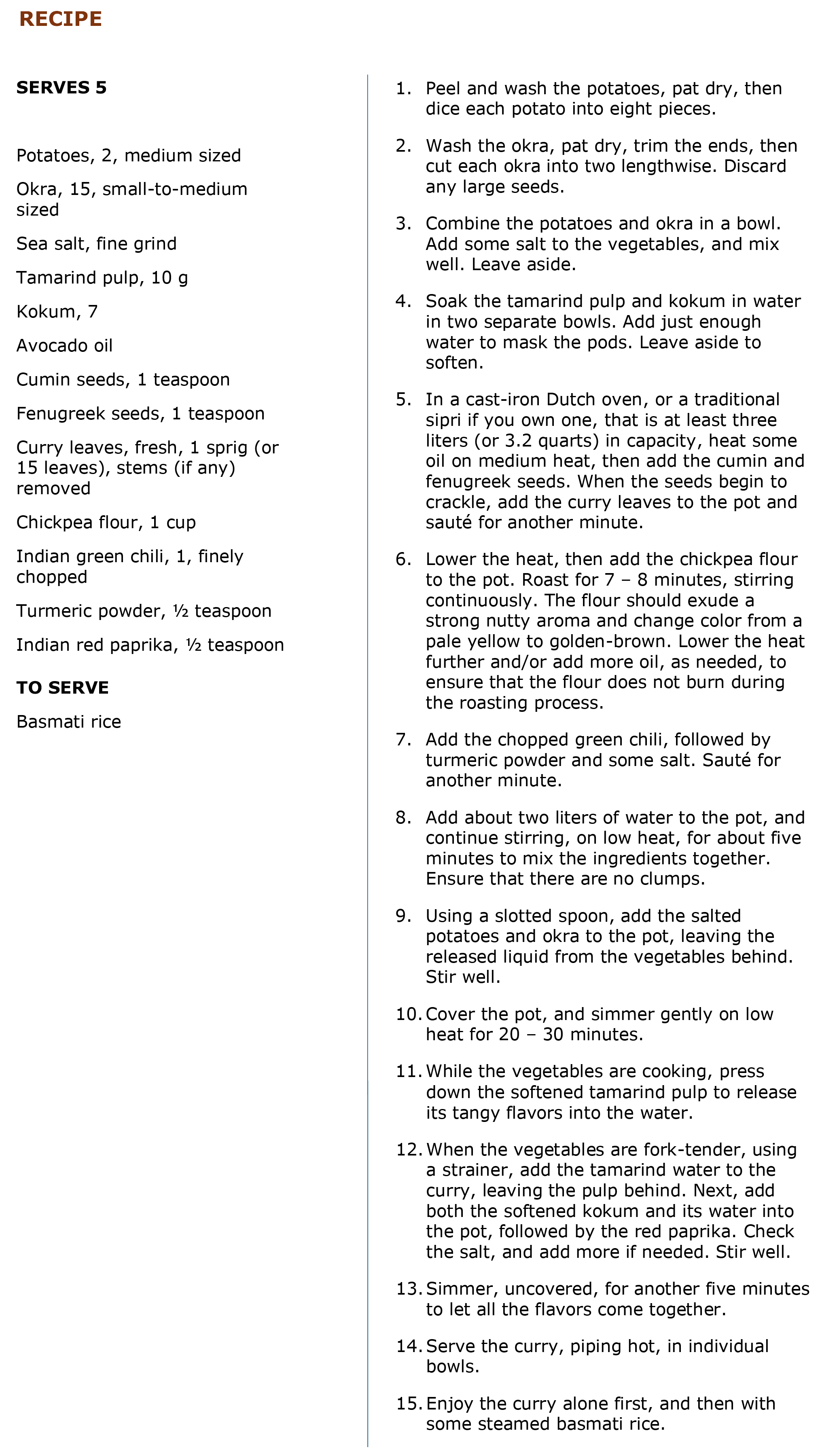
COOKING NOTES
On Tamarind Pulp: It can be found at Indian grocery stores. It is usually sold packed tight in a slab.
On Kokum: Kokum is a souring agent native to the Western Ghats of India. Unlike tamarind, which is intensely sour, kokum is far more restrained. Its flavor is more complex—tangy yet fruity, with earthy and floral undertones. You can find it at most Indian grocery stores.
On Spices: Buy spices, such as cumin, fenugreek, turmeric and paprika, at a spice store over a regular grocery store. For high-quality Indian spices, I recommend The Reluctant Trading Experiment. Their spices are a game changer, though the selection is somewhat limited.
On Curry Leaves: Fresh curry leaves can be found at Indian grocery stores. They can be substituted by dried leaves if fresh are not available.
On Chickpea Flour: It can be found at Indian grocery stores. It is also sold under the names of besan and gram flour.
On Indian Green Chili: As the name suggests, it can be found at Indian grocery stores. It can also be conveniently substituted by Thai chili pepper, which is similar in size and intensity and more widely available.
On Basmati Rice: Buy your basmati rice at an Indian or Pakistani grocery store. Buy regular, and not sella, basmati rice. The former is ideal with curries. Sella basmati, on the other hand, is parboiled and preferred in dishes where the rice grains need to stay separate and firm, such as in a biryani or pilaf.
Wow, I did not know about the pakoras, but it makes sense. Besan pakoras are commonly added to Punjabi curry; perhaps it's that influence on the Sindhis who settled in North India. My mom's Sindhi curry is much more minimal, although she does include cluster beans and drumsticks, when available. I prefer the simpler version; keeps the focus on the curry!
Love measured in simmer-time. ❤