Bigoli in Salsa
Thick Venetian bigoli pasta in a sauce that balances the sweetness of slow-cooked white onions with the umami of salt-cured fish. Nutty, rustic, and deeply satisfying.

Nutty, sweet, and savory: In equal measures
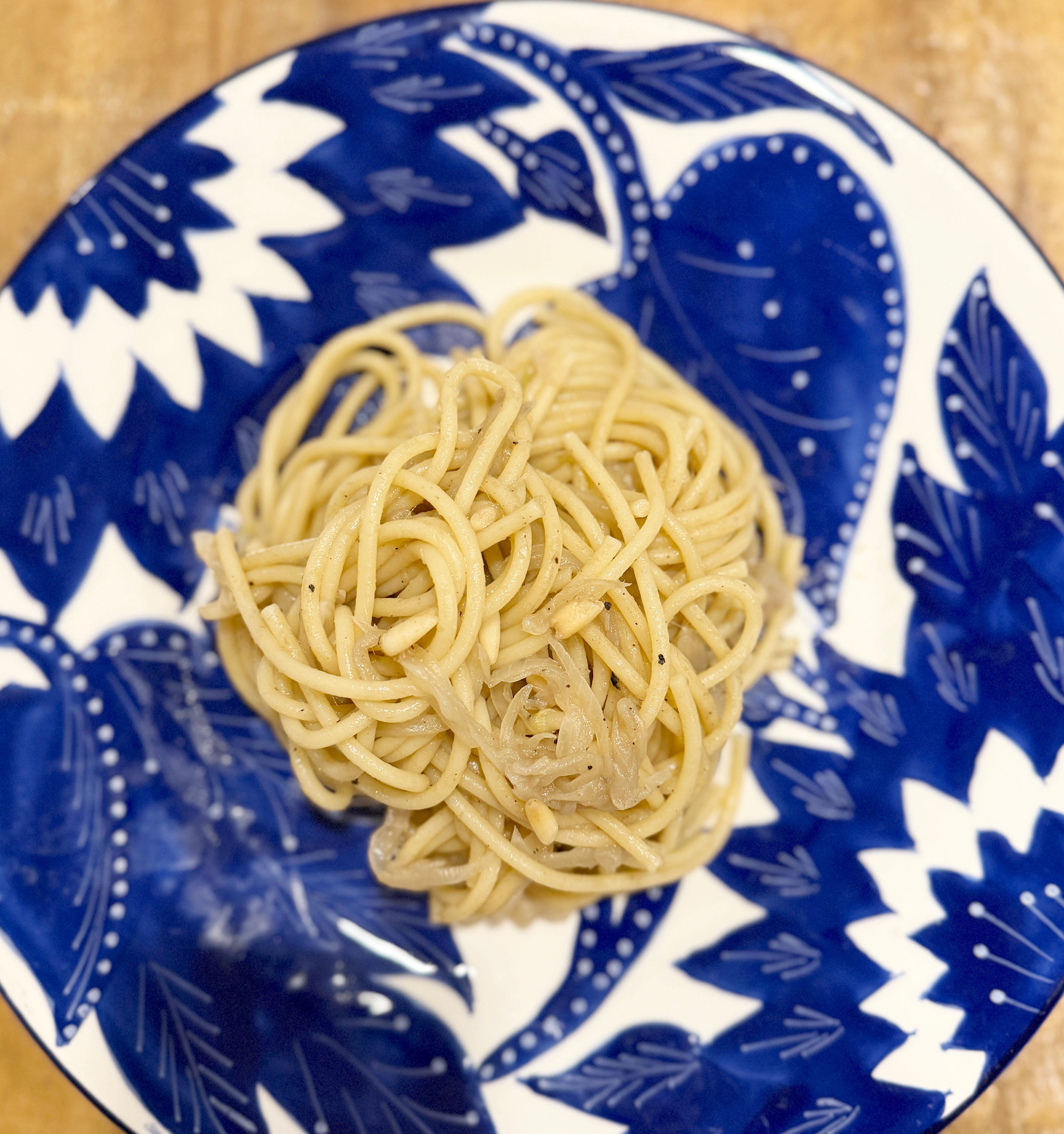
It doesn’t look like much. Bigoli in salsa—the Venetian pasta classic—is pale brown and glossy, its rustic strands speckled with slow-cooked onions. The bigoli—a tube-shaped pasta, thicker than spaghetti, typical of the Veneto region—are firm and chewy. They arrive dressed in olive oil with a deep savory richness, the onions softened to near invisibility, and the anchovies present only in essence. The first bite opens on the gentle sweetness of onions before giving way to the briny depth of anchovies. The nuttiness of the bigoli pairs beautifully with the onions and anchovies, while the bite of the pasta stretches the savor and lets the umami linger.
The onion is the quiet engine of so many cuisines, its sweetness most often coaxed out through browning—the slow caramelization that defines dishes from French boeuf bourguignon to Mughal biryanis. But there is another, less-visited path to onion sweetness, one that deliberately resists caramelization. In bigoli in salsa—as in Sindhi seyal dishes, a far-off parallel—the onion is softened without ever darkening, its color kept pale and its sweetness gentle and restrained.
The first time I tasted bigoli in salsa, in Venice, I was struck by its uniqueness and depth of flavor. The onions formed the backbone of the pasta sauce, while the anchovies receded in the background, lending a quiet briny presence. I had read that the sauce relied on just those two ingredients, yet the flavor felt far more complex than that simple combination suggested. The bigoli itself—thick, rustic, and made from whole wheat—held the sauce beautifully; its texture, rough and porous, and hearty chew revealed the flavors with each bite. The dish was almost pale—though it is sometimes speckled with parsley to bring in color. Even with the first mouthful, I knew this would not be an easy dish to recreate, and that mastering it would require finesse to achieve the delicate balance between the sweetness of onions and the umami richness of anchovies. I also suspected there were more ingredients at play. Bigoli in salsa, however, is not an easy pasta dish to find outside Italy—let alone outside Venice—and I found myself telling my son that I had to learn how to make it. He shook his head emphatically, as if to say I might not do it justice, and he seemed right: there was a certain complexity to the dish that made it feel elusive.
Oh, how wrong I was—and we are only better for it. The sauce is indeed simple: nothing more than onions and anchovies, with a little water to help the onions soften without caramelizing (and, of course, some olive oil, used sparingly). Once the onions have nearly collapsed, the anchovies are worked in and cooked until they disappear, leaving behind a creamy emulsion.
Discover the full range of stories and recipes in the Culinary Index, and explore lesser-known ingredients in the Ingredient Spotlights—both now featured on Savor the Story homepage.
Despite its apparent simplicity, bigoli in salsa has roots stretching back to medieval times. The dish, which likely originated in the 14th century, aligns closely with Jewish kashrut dietary logic, relying on kosher fish, onions, oil and grains. Its compatibility with Christian fasting practices—particularly meatless days—may help explain how similar preparations found resonance beyond the Venetian ghetto, becoming part of the lagoon’s broader culinary repertoire. Its fame grew further after Bartolomio Veronese—a pasta maker from nearby Padova—developed the torcio bigolaro, a hand-cranked wooden press for extruding bigoli, in 1604.
Traditionally prepared with sweet, tender white onions from Chioggia (located at the southern end of the Venetian lagoon), salt-preserved sardines, and bigoli made from buckwheat flour, bigoli in salsa is a dish from working-class traditions. It was typically prepared when fresh ingredients were scarce or on “lean” days—those on which meat was prohibited—such as Christmas Eve, Ash Wednesday, and Good Friday, but is now enjoyed year-round. Due to the ease with which anchovies dissolve and the resulting texture of the pasta sauce, which is smoother compared to that obtained with sardines, the use of anchovies in the dish has gradually increased over time. Contemporary versions in Venice continue to use either fish, almost always salted. Outside Venice, however, anchovies dominate. Buckwheat has largely given way to whole-wheat bigoli, both within and beyond the lagoon. White wine, used instead of water to soften the onions, and a garnish of parsley (and sometimes even toasted breadcrumbs) are modern additions. And, as is true of a number of Venetian dishes today, spices and nuts—markers of the city’s once-flourishing maritime trade with eastern Mediterranean ports such as Constantinople (now Istanbul) and Alexandria—have fallen out of favor: a pinch of cinnamon and black pepper was once customary in elite renditions of bigoli in salsa, as were smatterings of raisins and pine nuts.

Scroll down for the recipe, which leans on the traditional side. A white such as the Soave from the Veneto is the classic wine pairing, but I prefer the crispness and subtle salinity of the Ribolla Gialla to the minerality of Soave.
Nutty, gently sweet, and deeply savory, this Venetian pasta classic is unforgettable—like the city itself.
COOKING NOTES
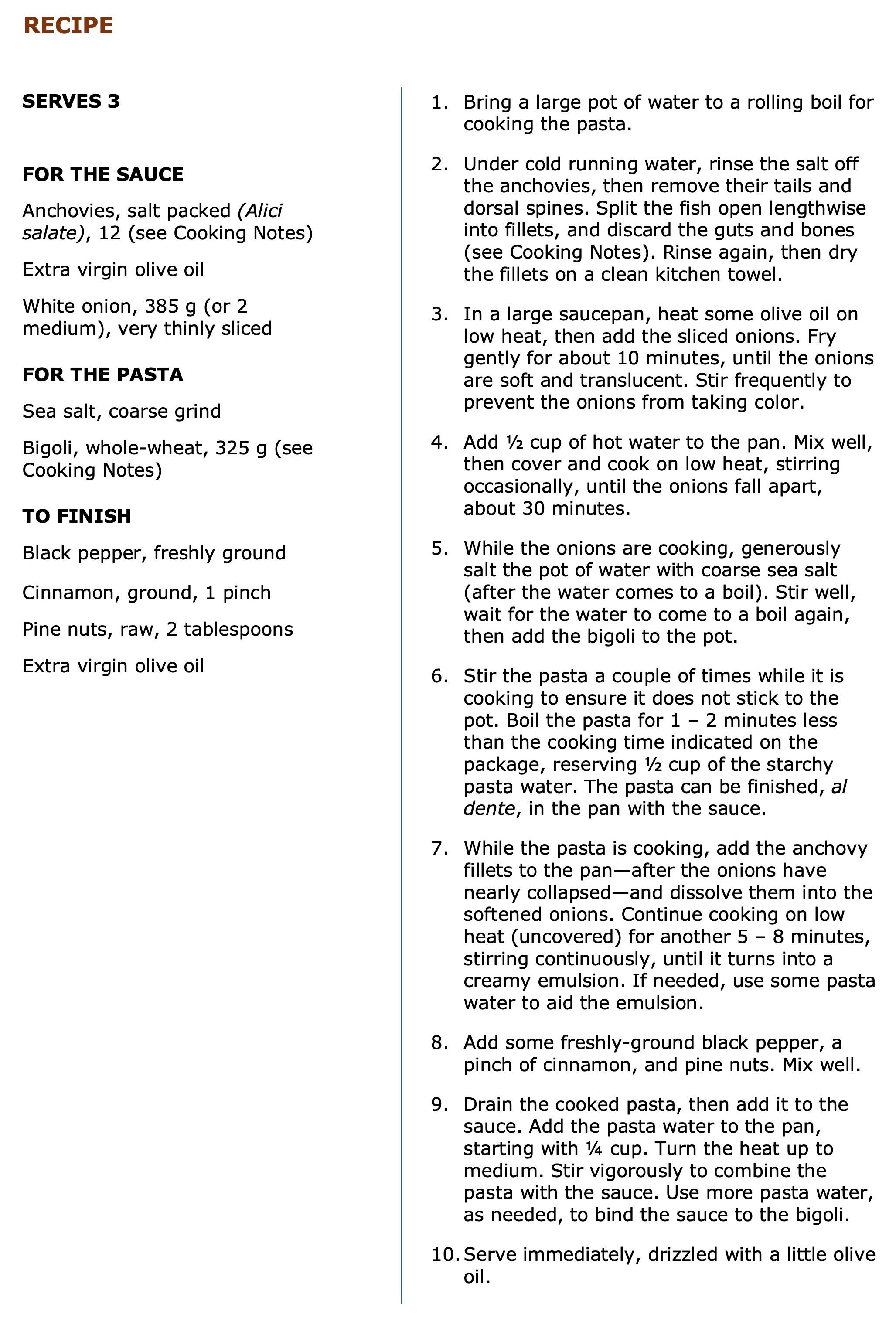
On Anchovies: Use salt-packed anchovies in this dish; the ingredient list should include only anchovies and salt. Anchovies preserved in salt are less widely available than oil-packed ones, but they are essential here. High-quality salt-packed anchovies from Cetara—such as those produced by Nettuno—are an excellent choice.
Before using salt-packed anchovies, rinse the salt off under cold running water, then remove their tails and dorsal spines. Split the fish open lengthwise into fillets, and discard the guts and bones (as shown here). Rinse again, then dry the fillets on a clean kitchen towel.
On Bigoli: This recipe calls for whole-wheat (also referred to as whole-meal) bigoli, a tube-shaped pasta, like spaghetti but thicker, with a rough texture. The nuttiness of whole-wheat bigoli pairs beautifully with the sweet and savory flavors of the sauce, while its rough texture helps the sauce cling to the pasta. Bigoli can, however, be hard to find outside the Veneto. Look for it at Italian or specialty food stores. Otherwise, buy bigoli online here.